
What is Grid Trading? Strategy, Types & Automated Grid EA to Capitalize Market Volatility
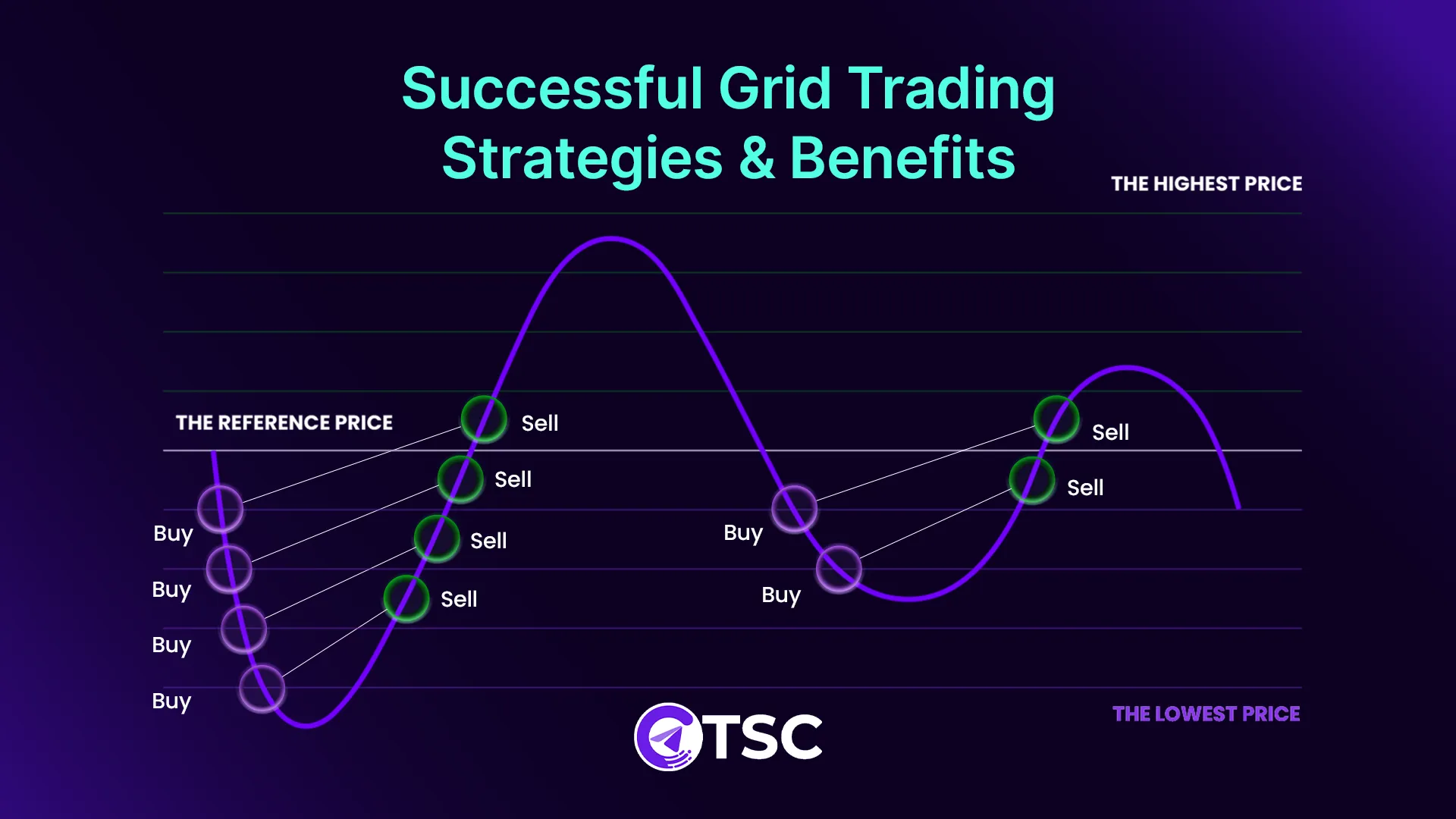
Thinking about profiting from the market volatility? Wait! We’re not talking about news volatility! Instead, we’re talking about capturing profit and recovering your losses when the market is volatile, and no strong trend is present.
To capitalize on the volatile market, nothing can beat a successful grid trading strategy. However, before attempting to apply the grid strategy to our account, ensure you understand the types, variations, and optimal execution.
In this blog, we will guide you through a comprehensive overview of grid trading, its types, and the best strategies to profit from the volatile market, just as expert traders do. Let’s start.

What is Grid Trading?
Grid trading is an advanced trading strategy where multiple buy and sell orders are placed at a definite price interval. This trading strategy is widely used by expert traders worldwide to take advantage of market volatility and trade without market prediction.
Sometimes the price fluctuates a lot without following any trend pattern. This is when grid trading comes into play. The main concept is repeatedly buying at a specific price and waiting for the price to drop andat the same sell orders are placed to cover the loss for the buy executed buy order.
In a grid trading strategy, traders place multiple buy and sell orders. These are basically limit orders at a fixed price level to capture a small but more profitable amount. These multiple trades are called grid levels, and the entire process is best known as a basket of grids or basket trading, or grid trading.
Advanced traders apply the grid trading strategy to capture more profit to recover the overall losses. And this comes with high risk.
How Does Grid Trading Work?
Grid trading works by placing multiple buy and sell orders at fixed price intervals. These trades are placed under one open trade, which helps to determine the price interval for the grid levels.
The intervals of grids are called grid gaps, and they can be determined based on the market volatility. Each grid has an upper price level considered as resistance and a lower price level considered as support.
The resistance is the highest price below which all buy limit orders are placed, and the support is the lowest price above which all sell limit orders are placed.
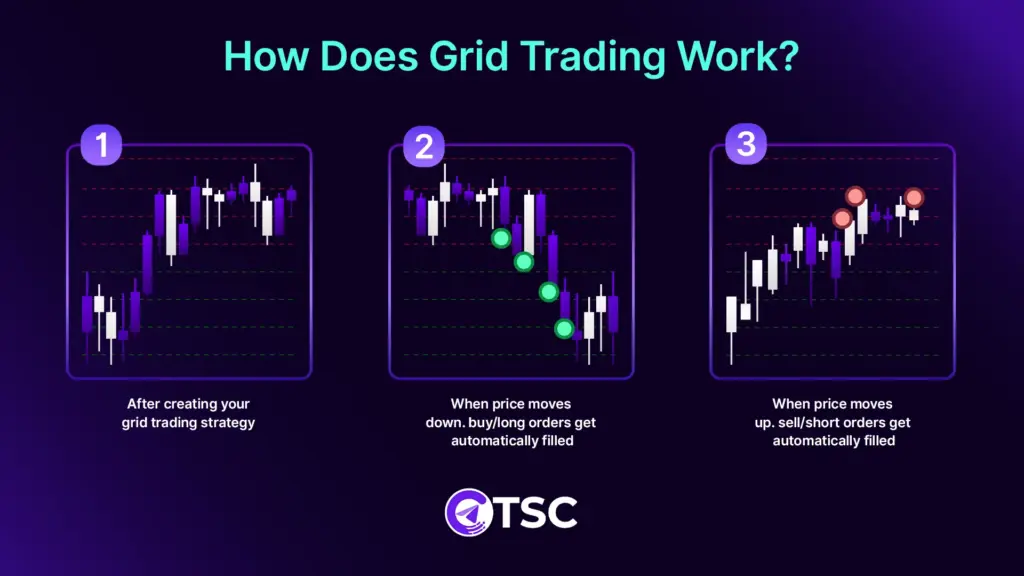
Grid trading is ideal for volatile range-bound markets like the Forex and Crypto. If we take a look at how grid trading works, the steps are as follows-
Defining the Range
Set a price range for the basket of grids. If you use MetaTrader platforms like MT4 / MT5, use the EMA (Exponential Moving Average) tool to identify support and resistance levels.
Setting the Grid Spaces
Then, set the grid spaces or the grid intervals. It can be kept either a fixed grid interval for all the open trades or different intervals for different grid trades.
Executing Grid trades
Finally, executing all the grids at a time. When the price oscillates, the profit triggers through the entire basket.
As grid trading basically consists of multiple limit orders, when the price dips to a buy level, the buy orders are executed with small profit secured, and when the price then rises to a corresponding sell level, the sell limit order is executed with a small profit.
Profiting & Repeating the Process
This process continuously generates small profits as the price moves back and forth within the basket. Profits might be tiny, but when calculated overall, the anticipated loss is recovered.
Market Logic Behind Grid Trading (Why It Works)
The market logic behind the grid trading is to capture profits, yet small from the natural market volatility. Grid trading relies on the mean reversion technique, where it is predicted that the prices to return to an average between the grid range.
Grid trading works only during a range market or a sideways market where the price does not follow any strong trend.
According to multiple Journal of Finance studies and Science Direct, most of the liquid financial assets spend 70% ranging regimes and 30% trending regimes.
Therefore, this market ranging behavior gives grid trading or high-frequency trading (HFT) a green flag.
What are the Types of Grid Trading Strategies?
Grid trading strategies types can be categorized based on 3 things: grid interval, execution, and placement. Based on these categories, grid trading can be of different types.
Let’s check out all the types one by one-
Grid Trading Based on Grid Interval
That said, two types of grid spaces can be implemented in grid trading, these are-
1. Fixed Grid Trading
Fixed grid trading uses equal price or pip gaps between every grid level. No matter how many gridof baskets you place, all of them maintain a fixed space between the grids.
How It Works:
- Choose a fixed distance (for example, 20 or 50 pips) between grid levels.
- Place buy orders below the current price at equal intervals.
- Place sell orders above the current price at equal intervals.
- Each price move between grid levels captures small profits repeatedly.
| Pros ✓ | Cons ✕ |
|---|---|
| Easy to understand and set up | Does not adapt to sudden volatility |
| Can be automated with EAs | Can struggle during strong breakouts or news events |
| Suitable for range-bound markets |
2. Dynamic Grid Trading
Here, all the trades inside the basket are placed at different intervals based on the market volatility. So, this automatically adapts to the market volatility caprturing more profits from price shifts.
How It Works:
- Grid spacing changes automatically based on volatility indicators.
- Wider grids are used during high volatility.
- Tighter grids are used during low volatility.
- The strategy adapts to capture larger price swings.
| Pros ✓ | Cons ✕ |
|---|---|
| Adapts to changing market conditions | More complex to configure |
| Better suited for volatile assets like crypto | Usually requires automation to work effectively |
| Can reduce overtrading in fast markets |
Grid Trading Based on Trade Execution
Based on how grid orders are placed, grid trading strategies are of 2 types-
1. Manual Grid Trading Strategy
Manual grid trading involves placing and managing grid orders by hand, without using bots or automation tools. Manually placing grids can be hectic and might be highly risky.
How It Works:
- The trader manually places buy and sell orders at grid levels.
- Orders must be monitored and adjusted frequently.
- Risk management depends entirely on the trader.
| Pros ✓ | Cons ✕ |
|---|---|
| Full control over every trade | Time-consuming and stressful |
| No dependency on software | High risk during volatile markets |
| Difficult to manage multiple grid levels |
2. Automated Grid Trading Strategy (Bots & EAs)
Automated grid trading uses grid bots or Expert Advisors (EAs) to place, manage, and close grid trades automatically. It is one kind of volatility trading strategy.
This is the most popular method among grid traders, especially in forex and crypto markets.
How It Works:
- A bot or EA places grid orders based on predefined settings.
- Trades are executed automatically without manual input.
- Risk controls and position management run in the background.
| Pros ✓ | Cons ✕ |
|---|---|
| Removes emotional trading | Requires proper setup and testing |
| Works 24/7 without constant monitoring | Poor configuration can increase risk |
| Ideal for volatile and fast-moving markets |
Here are some prevalent grid trading strategies tailored to specific market conditions-
Grid Trading Strategy Based on Placement
Based on the market volatility and grid placement methods, there are some variations of grid trading strategies. Such as-
1. Range-Based Grid Trading
The range-based grid strategy is the most popular and widely used form of grid trading. It works best when the market is moving sideways, and clear support and resistance levels are noticeable.
According to CME Group market studies, major forex pairs trade in range-bound conditions nearly 60–70% of the time. So, this makes this strategy highly practical for FX traders.
How It Works:
- Identify a price range where the asset frequently moves up and down.
- Buy orders are placed at suitable intervals below the current price.
- Sell orders are placedat suitable intervals above the current price.
- Each price fluctuation within the range generates small, repeated profits.
| Pros ✓ | Cons ✕ |
|---|---|
| Easy to understand and automate | Strong breakouts can cause losses if the grid is not adjusted |
| No need for market prediction | |
| Works best in both forex and crypto markets |
2. Trend-Following Grid Trading
The trend-following grid strategy is suitable for trending markets by adding a directional bias. Instead of trading both sides equally, the grid favors the direction of the dominant trend.
A Nasdaq market behavior report highlights that trending phases, while less frequent, account for a large portion of total market movement.
How It Works:
- Identify a strong uptrend or downtrend using trend indicators or EMA (Exponential Moving Average).
- In an uptrend, long more with short at the same time at higher levels.
- In a downtrend, sell orders dominate the grid structure.
- Pullbacks within the trend are used to enter trades.
| Pros ✓ | Cons ✕ |
|---|---|
| Can be profitable during sustained trends | Trend reversals can quickly reduce profits |
| Comparatively less risky | Requires reliable trend confirmation tools |
| Suitable for swing traders using automation |
3. Hedging Grid Trading
The hedging grid strategy mainly focuses on reducing directional risk by opening both buy and sell orders within the basket. It aims to profit from volatility rather than price direction, which completely aligns with the grid concept.
This approach is often used by traders who prefer a non-directional strategy. This is the best strategy for crypto volatile markets.
How It Works:
- Place buy and sell orders at equal distances above and below the current price.
- As price moves, one side becomes profitable while the other side adheres to risk.
- Then, profits are generated from frequent price swings.
| Pros ✓ | Cons ✕ |
|---|---|
| No market prediction is needed | Strong one-directional trends can cause huge losses |
| Performs well in volatile and uncertain markets | Over-hedging may reduce overall profitability |
| Can reduce emotional impact |
4. Martingale Grid Trading (High Risk)
The Martingale grid strategy is an aggressive approach that increases position size after each losing trade. This strategy is applied with the goal of recovering all losses from a single winning move.
Many don’t recommend this as an ideal grid trading strategy, as it’s more like betting than regular trading. Therefore, Many prop firms explicitly restrict or ban Martingale strategies due to their risk profile.
How It Works:
- Start with a small position.
- If the price moves against the trade, place the next grid order with a larger lot size.
- Once the price reverses, accumulated losses are recovered.
| Pros ✓ | Cons ✕ |
|---|---|
| Quick profit gain in strong-ranging markets | Requires a large capital account |
| No proper entry schedule needed | Extended trends can wipe out accounts quickly |
| Not suitable for beginners |
5. Anti-Martingale Grid Strategy (Lower Risk Alternative)
The Anti-Martingale grid strategy follows the same martingale style but with a reverse concept. Instead, it takes a more conservative approach by increasing position size only after winning trades, not after losses.
Financial research studies suggest that risk-adjusted returns improve when exposure increases during favorable conditions rather than after losses.
How It Works:
- Similar to the martingle grid, start with a small position.
- When profit hits, the position size increases.
- When loss occurs, position size is reduced to protect capital.
| Pros ✓ | Cons ✕ |
|---|---|
| Lower drawdown risk compared to Martingale strategies | Less effective in sideways markets |
| Disciplined risk management approach | Requires accurate trend identification |
Fixed Grid Trading vs Dynamic Grid Trading
Grid Trading Rules You Must Follow
Grid trading should not be practiced during high-impact news events. It’s only effective during a normal market volatility period. Besides, some must -follow rules for drawdown protection during grid trading are-
- Never over-leverage grid systems
- Limit maximum grid levels
- Always define total capital exposure
- Avoid high-impact news events
- Use volatility filters
- Use an indicator for range confirmation
Advantages of Grid Trading
Grid trading comes with several benefits and risk protection, like-
- Stress-Free Trading: Grid trading helps to trade without taking the stress of market analysis.
- Advantage of Volatility: The grid trading strategy works and helps to profit only when the market is choppy and volatile without any news events.
- Major Market Cover: Grid trading efficiently works in major financial markets like Forex and Crypto.
- Smarter Risk Management: Grid trading offers an opportunity to recover losses and manage risks smartly.
Grid Trading Risks
Grid trading exposes higher risks along with the profit opportunities, such as-
- Capital Investment: Grid trading requires a higher capital account to invest initially.
- Account Wipe out: Losing in grid trading can wipe out the entire account balance if not properly managed risk.
- Wrong Strategy: Wrong grid settings can lead to huge irreparable losses.
- News Volaitlity: Never works in news, even volatility
What Is Grid Trading In Forex?
Grid trading in Forex refers to trading with a grid strategy in the Forex market. Forex grid trading strategy helps to trade the Forex currency pair that ranges using tight spreads and high liquidity.
EUR/USD, GBPUSD, and USD/JPY are the best forex pairs for grid trading, recommended by most of the institutional traders. These pairs show stable volatility and deep liquidity, according to CME FX volume reports.
The forex market sometimes becomes so choppy that profit becomes horrible sometimes. This is when the grid strategy works effectively to capture profits easily without any market predictions and analysis.
What Is Grid Trading In Crypto?
Trading applying the grid strategy in the cryptocurrency market is called grid trading in Crypto. Crypto markets exhibit high intraday volatility, which is perfect for grid execution. Crypto grid trading benefits from high volatility and 24/7 markets, making automation highly effective for non-trending environments.
Binance Research notes that extended consolidation phases often follow major price moves, creating ideal market states for grid trading. BTC/USDT, ETH/USDT, and BNB/USDT are the best crypto pairs for grid trading.
Grid Trading Automation Using Bots & Expert Advisors

Using the best grid trading automation tool, like the Telegram Signal Copier grid EA, you can profit from the market volatility. To set the grids with proper grid intervals, identifying range can be skeptical. But Telegram Signal Copier (TSC) grid EA is such a specialized tool that helps in setting the grids with ease and full automation.
Grid strategy requires a potential preset of order placement defining the range bound. Telegram Signal Copier (TSC) grid EA tool does that within seconds using 3 effective indicators- EMA, ATR, and RSI. These indicators work behind every grid placement.
Besides, the complete grid customization in the TSC grid EA makes it an ideal trade automation tool to maximize profits in range-bound markets.
Best Risk Management Practices For Grid Traders
To survive long-term trading profits-
- Limit leverage to 1–3x
- Use maximum grid limits
- Pause grids during breakouts
- Never apply grid on strong trends
- Avoid martingale grids
Who Should Use Grid Trading?
Grid trading is best suited for experienced traders, algo traders, and professionals who understand volatility and drawdown risk. Besides, high-frequency traders, like scalpers, can go for grid trading to capitalize on the non-trending, volatile market.
However, make sure the market volatility is natural market volatility, not for any high-impact news volatility.
Final Verdict
Grid trading strategy is a special type of trading strategy to profit from the normal market volatility. And it is efficient using a grid automation tool like TSC (Telegram Signal Copier).
TSC grid EA comes with complete customization for grid levels in the grid trading. And the best part is that TSC Grid EA is an individual tool that can be easily installed on the platform.
To learn more about TSC grid EA and its function, contact TSC support hero, available for you 24/7.
Grid Trading FAQs

Future grid trading is the automatic grid trading strategy applied to the future contracts using grid trading bots or Expert Advisor.
Spot grid trading is placing multiple buy and sell orders 24/7 on the spot market. Mostly, spot grid trading is an automated quantitative strategy.
Yes, grid trading is profitable in the ranging, sideways market, if applied correctly.
Bitcoin (BTC/USDT) is the best cryptocurrency for grid trading for high liquidity, market volatility, and a range-bound asset.
No, grid trading is not safe for beginners. But using a trading automation tool like grid trading EA, beginners can also profit.
No, grid trading is not illegal. It is just a systematic trading strategy for advanced-level traders. So, grid trading is considered legal and allowed by most of the regulated brokers.
Technically yes. But not all prop firms allow grid trading. Popular prop firms like FundedNext strictly prohibit grid trading. Besides, FTMO allows grid strategy on some conditional risk control.