


Prop Firms That Allow Copy Trading: Everything Prop Traders Need to Know
Proprietary trading firms (prop firms) are financial entities that fund independent traders with firm capital, allowing them to trade larger positions without risking only their personal funds. In most modern funding programs, traders operate under predefined risk rules, such as daily drawdown limits, profit targets, and position restrictions.
Prop firms that allow copy trading combine two powerful ideas in modern trading: funded accounts and automated trade replication. For traders, this automation plays a strategic role.
If you’re exploring prop firms that allow copy trading or want to learn how to manage multiple funded accounts more efficiently, this guide explains which firms permit copy trading, what risk rules typically apply, and how automation platforms help traders scale their strategies across multiple funded accounts efficiently.

What is Copy Trading in Proprietary Trading Firms?
Copy trading in proprietary trading firms refers to the automated replication of trades from one trading account to another within a prop firm’s trading environment. In simple terms, copy trading mirrors trades from a master account to one or more secondary accounts, ensuring the same entry price, stop-loss, and take-profit parameters are executed simultaneously.
This process is usually performed through trade copier software integrated with trading platforms, allowing funded traders to replicate strategies across multiple accounts while maintaining consistent execution.
Why Prop Traders Prefer Copy Trading?
Prop traders often use copy trading to manage multiple funded accounts efficiently while maintaining consistent strategy execution.
The main reasons why proprietary traders prefer copy trading:
- Scalability Across Multiple Accounts
- Consistent Strategy Execution
- Time Efficiency and Automation
- Improved Risk Management
- Reduced Emotional Trading
For individuals trying to become a prop trader, copy trading provides a structured way to manage multiple accounts, maintain consistent performance, and build scalable trading operations within the strict rules of proprietary trading firms.
Do Prop Firms Allow Copy Trading?
Some proprietary trading firms allow copy trading, while others restrict or completely prohibit it. The policy usually depends on each firm’s internal compliance rules and risk management framework. Certain firms permit internal copy trading, but many firms strictly limit or ban the use of third-party signal providers or external copy trading networks.
The real challenge for prop traders is that these rules are not always clearly explained on the firm’s website. As a result, traders often end up searching through forums, blog posts, or third-party websites to understand whether copy trading is allowed.
A more reliable approach is to verify the information directly with the prop firm. Contacting the firm’s support team ensures traders receive the most accurate and up-to-date explanation of their copy trading policies.
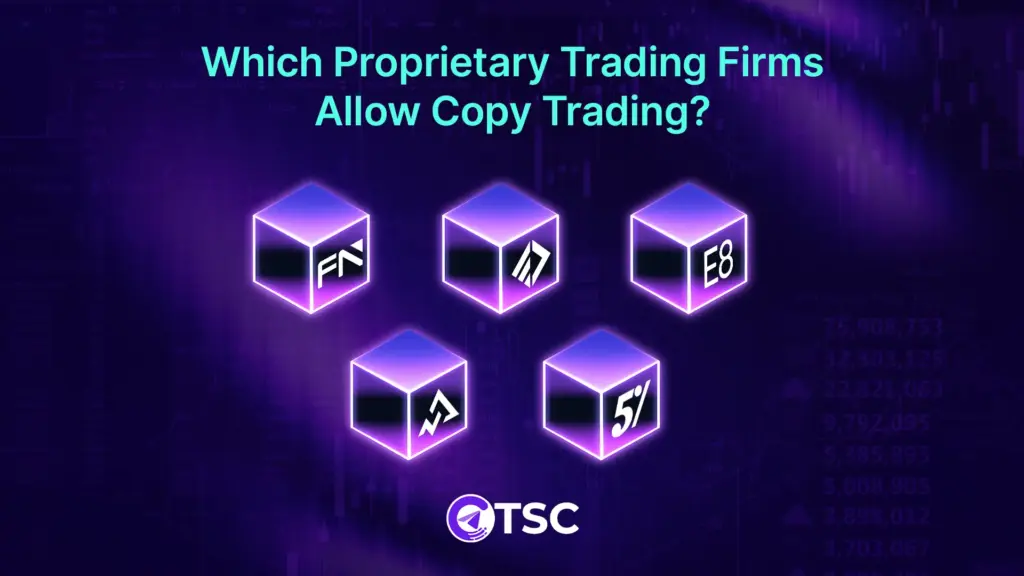
Which Proprietary Trading Firms Allow Copy Trading?
Not all proprietary trading firms treat copy trading the same way. For traders researching prop firms that allow copy trading, reviewing each firm’s rules, automation policy, and platform compatibility is essential.
In the next sections, we will explore some specific firms that allow copy trading and the conditions traders must follow to remain compliant.
FTMO
FTMO is one of the most recognized proprietary trading firms operating a structured trader funding program designed to identify disciplined and consistently profitable traders. The FTMO prop firm provides access to significant trading capital after traders successfully complete its evaluation process, commonly known as the FTMO Challenge.
Since 2015, they have been helping traders test their skills in a simulated trading environment and see if they meet the required criteria to become a prop trader. Only traders who demonstrate consistent strategy execution and strong risk control are eligible for an FTMO-funded account.
FTMO Copy Trading Rules
FTMO allows copy trading only between accounts owned by the same trader. You can replicate trades across your FTMO accounts using trade copiers. FTMO prohibits third-party signals, shared accounts, or group trading.
FTMO enforces compliance through advanced risk monitoring systems that detect identical trade patterns, including entry points, lot sizes, and execution timing, ensuring independent trading behavior and strategy development.
FundedNext
FundedNext is a proprietary trading firm that provides structured funding programs for traders seeking access to larger trading capital. The firm has gained popularity among modern proprietary traders because of its flexible account options, structured rules, and clear evaluation framework.
During this FundedNext Challenge evaluation phase, traders must meet specific performance metrics such as profit targets while staying within defined risk limits, including maximum drawdown and daily loss thresholds. Like most professional funding programs, FundedNext maintains strict monitoring systems to ensure traders follow its trading policies and protect the firm’s capital.
FundedNext Copy Trading Rules
FundedNext permits copy trading only when all linked accounts belong to the same trader. Traders may need to verify ownership before using trade copier tools. The firm strictly prohibits third-party signal providers, group trading, and copying trades from other individuals, including friends or family.
FundedNext monitors trading activity for duplicate patterns such as identical entries, lot sizes, and execution timing. Violations of these rules may result in disqualification or account termination, reinforcing fair trading practices and individual accountability.
E8 Markets
E8 Markets is a proprietary trading firm, structures its programs around performance evaluations designed to assess a trader’s discipline, consistency, and risk control. E8 Markets was founded in 2021, located in the United States. They pride themselves on being the first USA-based, remote trading firms.
E8 Markets has gained attention in many prop firm reviews as a platform that supports both discretionary trading and algorithmic strategies. Like most funding programs, the firm maintains clear rules to ensure traders operate independently and follow the firm’s capital allocation policies.
E8 Markets Copy Trading Rules
E8 Markets allows copy trading across accounts owned by the same trader, including evaluation, funded, and even external broker accounts under personal control. This flexibility supports traders using automation and portfolio scaling strategies.
However, the firm strictly prohibits third-party signal services, copying trades from other traders, and coordinated group trading. Any attempt to replicate trades from external sources or operate as a trading team violates E8 Markets’ policies and may lead to penalties or account suspension.
Alpha Capital
Alpha Capital Group operates as a proprietary trading firm that provides traders with access to funded trading accounts after successfully completing its evaluation process. Alpha Capital started its journey in November 2021, and the group aims to create a transparent, supportive environment that sees the traders as a partner, not just a user.
Many Alpha Capital firm reviews highlight the firm’s emphasis on transparency and compliance in trading practices. Rather than focusing solely on profitability, the evaluation framework prioritizes sustainable trading methods and responsible strategy execution.
Alpha Capital Copy Trading Rules
Alpha Capital allows copy trading after verifying the master account, including account number and server data. You can copy trades only between your own accounts. The firm prohibits copying trades from other traders, signal services, or coordinated trading groups.
Violations may trigger compliance reviews, potentially resulting in revoked trading privileges or account termination to maintain fair and independent trading practices.
5%ers
The 5%ers is a proprietary trading firm that provides traders with access to funded accounts while emphasizing disciplined, low-risk trading strategies. The firm offers multiple funding programs designed for different trading styles, allowing traders to scale capital gradually based on performance.
Unlike many prop firms, it focuses on long-term consistency rather than aggressive short-term gains, with strict risk management rules and clear evaluation criteria. This approach aims to develop independent, professional traders who can manage capital responsibly over time.
5%ers Copy Trading Rules
The 5%ers allows copy trading exclusively between accounts owned by the same trader. Users can replicate trades across their own accounts using manual or automated tools. However, copying trades from third parties, signal providers, or participating in group trading is strictly prohibited.
The firm also restricts certain third-party copy trading platforms to maintain independent strategy execution. Additionally, copy trading is not allowed between two Bootcamp accounts, and strategies like high-frequency trading or arbitrage are banned under their trading rules.
Now that we have talked about the prop firms that allow copy trading, let’s talk about a popular copy trading tool prop traders use to automate their trades to reduce stress and ensure time management. Prop traders use Telegram Signal copier during the proprietary trading firm challenges.
What is the Best Copy Trading Tool for Prop Traders?
A strong contender for the best copy trading tool for prop traders is Telegram Signal Copier (TSC), a software that automatically converts Telegram trading signals into live trades on platforms like MT4, MT5, cTrader, DXTrade, and TradeLocker. It uses AI-based parsing to interpret text, images, and multi-language signals, executing trades within seconds.
Prop traders prefer TSC because it improves execution speed, reduces manual errors, and supports multi-account scalability. Features like reverse trading, dynamic spread handling, and stealth mode align with prop firm rules and risk controls.
TSC enables consistent trade replication, time efficiency, and disciplined execution, which are critical for passing evaluations and managing funded accounts.
How Telegram Signal Copier Helps Prop Traders Copy Trade?
For prop traders aiming to pass evaluations and manage funded accounts, automation provides a powerful edge. Prop traders use Telegram Signal Copier because it automates signal execution, enforces risk management, and ensures consistent trade placement during the prop firm challenges.
Manual trading often leads to missed signals, delayed entries, and emotional mistakes. A well-configured TSC ensures that every trade follows predefined rules—without deviation. This level of consistency is exactly what prop firms look for.
For Prop Traders Who Want to Copy Trades
From a professional trading perspective, automation dramatically improves consistency. Prop firms typically enforce strict drawdown limits, position sizing rules, and stop-loss requirements. A well-configured signal copier ensures that each copied trade follows predefined risk parameters.
Instead of manually entering trades, the Telegram Signal Copier instantly translates signals into executed positions, ensuring accuracy and speed. Financial markets move quickly, and even a few seconds of delay can change an entry price or reduce profit potential. This level of execution precision is difficult to achieve manually.
Many prop traders cannot monitor the markets 24/7, yet prop firm challenges usually require reaching profit targets within a limited timeframe. By automatically executing signals around the clock, a TSC ensures that traders never miss high-quality opportunities because they are away from the screen.
For Prop Traders Who Want to Copy From Signal Providers
In the real trading world, many traders still rely on experienced analysts and signal services for market insights. TSC allows traders to introduce controlled variations in execution timing, trade parameters, and trade metadata. These adjustments can make trading activity appear unique on the broker’s side while still following the same core trading idea.
One practical method is delayed trade execution. Inside the TSC application, traders can access the “Additional Keyword” tab and configure the “Delay in Msec” setting. This feature intentionally delays trade execution by a specified number of milliseconds after a signal is received.
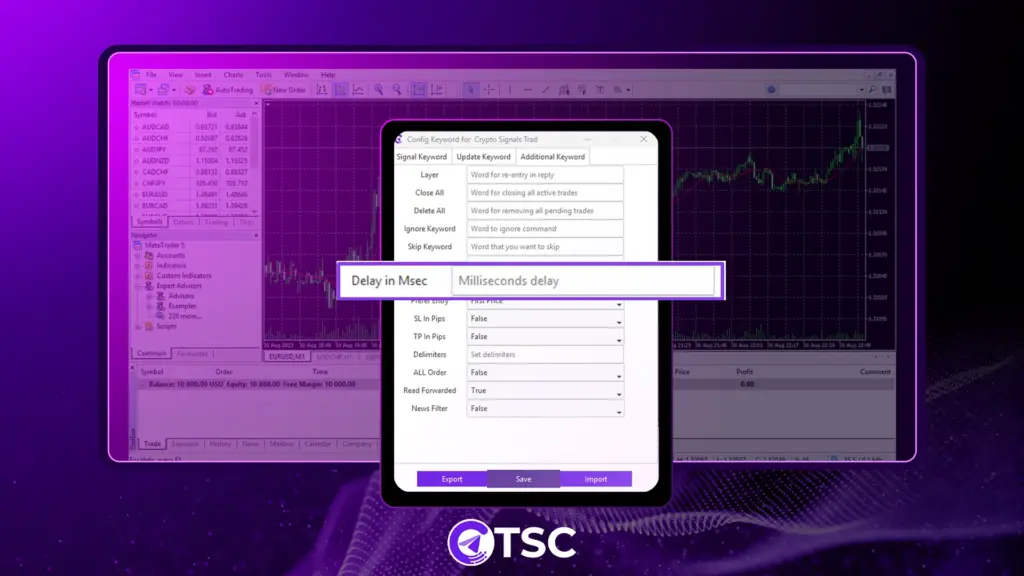
For example, setting the delay to 2000 milliseconds creates a 2-second delay between the signal provider and the executed trade. Even a small delay can break identical entry timing patterns across accounts, reducing the likelihood that monitoring systems detect synchronized trading behavior.
Another technique involves entry, stop-loss, or take-profit modification through the TSC Expert Advisor (EA). By adding or subtracting a pip value—such as +1 or −1 pip — the EA slightly modifies the entry price or SL/TP parameters compared to the original signal.
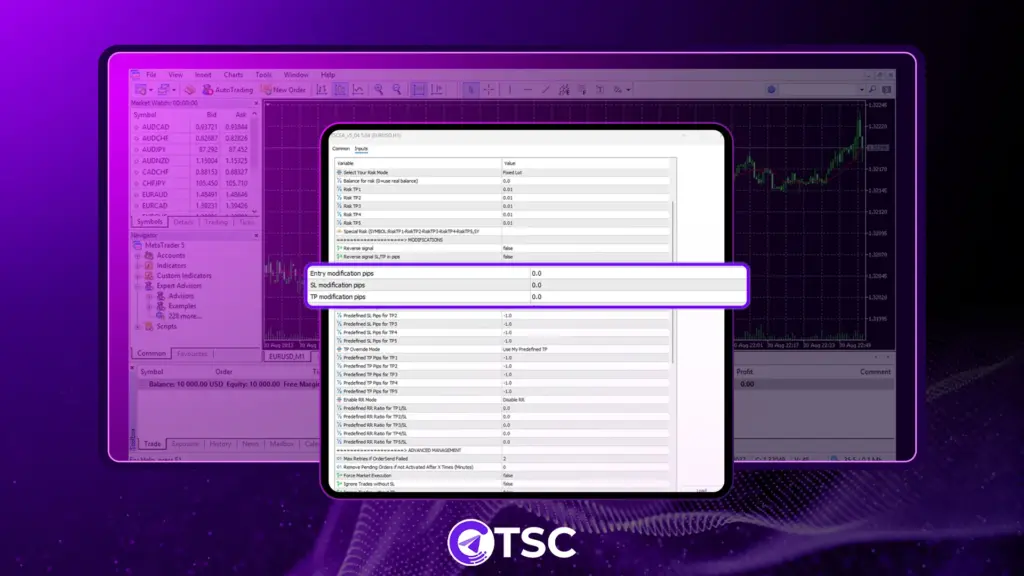
For example, if a signal recommends an entry at 20 pips, adding +1 pip will execute the trade at 21 pips instead. These small variations create unique trade fingerprints while maintaining the core trading strategy.
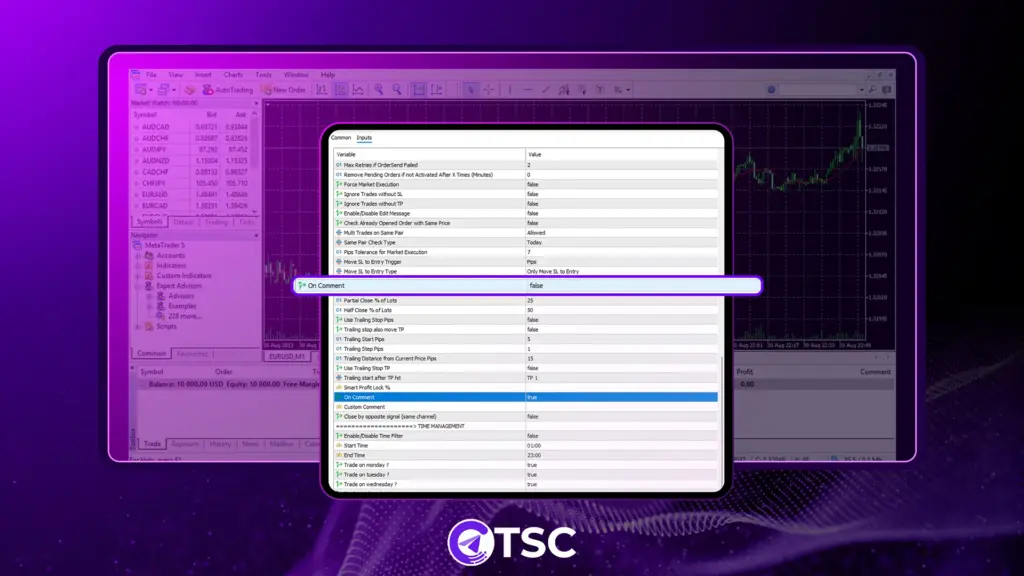
TSC also allows traders to remove signal provider identifiers from trade comments. Within the EA settings, traders can disable the comment field so the broker terminal does not record the signal provider’s name or tag. This reduces traceable links between the executed trade and the original signal source, helping traders keep their trading activity independent within the platform environment.
For Prop Traders Who Are Unsure About Prop Firm’s Copy Trading Rule
The safest approach is to contact the prop firm’s official support team directly. Their support staff can clarify whether copy trading is allowed, what limitations apply, and whether tools like a Telegram Signal Copier are permitted within their trading policies.
Traders should confirm:
- Whether the prop firm permits copy trading.
- Whether copying between personal and funded accounts is allowed.
- Whether external signal providers or trade copiers are restricted.
- Whether account-to-account latency or trade-size rules apply.
You can also contact The Telegram Signal Copier (TSC) support team. TSC staff analyzes prop firm compatibility with signal services and trade copier setups. Support teams can provide operational guidance based on platform integrations and prop firm policy constraints.
Final Thoughts
Copy trading has become an important operational tool for many proprietary traders who manage multiple funded accounts and strict risk parameters. As we’ve seen, several well-known firms permit some form of copy trading, but typically only between accounts owned by the same trader. At the same time, most firms strictly prohibit third-party signal services, group trading, or copying trades from other traders.
For traders who are considering automation tools or trade copiers, understanding these policies is essential to avoid violations that could lead to termination of the trader’s account. Take the time to review the firms, rules, and tools discussed in this article so you can choose the right proprietary trading environment for your strategy.
FAQs

A proprietary trading firm (prop firm) is a financial company that provides traders with capital to trade financial markets such as forex, stocks, indices, or commodities. Instead of trading their own money, traders use the firm’s funds and share a percentage of the profits.
Yes, prop firms are generally legal, because traders operate as independent contractors using the firm’s capital rather than managing external investor funds.
Prop firms typically pay traders through a profit-sharing model. Many prop firms offer profit splits ranging from 70% to 90% for the trader.
Many traders fail prop firm challenges due to poor risk management, emotional trading, or lack of strategy consistency. Common reasons include exceeding drawdown limits, overtrading, and failing to maintain stable performance over time.
Trading with proprietary firms can be beneficial for traders who want to scale their strategies with larger capital. Prop firms provide access to funded accounts and profit-sharing opportunities
To become a prop trader, a trader needs to register with a proprietary firm and pass its evaluation process. Traders who successfully complete the evaluation can receive a funded account and earn a percentage of the profits.
Well-known firms in the industry include platforms like FTMO, FundedNext, E8 Markets, Alpha Capital, and 5%ers.